

Overview
“Contexts are the essential ingredients of a sequence, and a sequence is constructed of progressively larger building blocks of these. Contexts are arranged firstly in ‘subgroups’ and then subgroups are arranged in ‘groups’, so that every context is in a particular subgroup and every subgroup is in a group. These terms are meant to be utilitarian and interpretatively neutral”
(Westman & Shepherd 1992, 439)
Stratigraphic grouping and subgrouping are techniques that are employed to help make sense of the temporal and spatial relationships within archaeological sites. When examining layers of sediment or soil, archaeologists often encounter complex sequences of deposits that require systematic analysis. Subgrouping refers to the process of identifying and categorising distinct subsets or subdivisions within a stratigraphic sequence. By scrutinising the characteristics of these subgroups (such as material culture, architectural remains, or geological composition) it may be possible to infer variations in chronology, function, or cultural affiliation. Subgrouping (when applied) is generally conducted before grouping, as it allows for a more nuanced understanding of the site’s development at a relatively fine level of granularity (i.e. at the level of individual pits, postholes, ditches etc.) and helps to facilitate the construction of meaningful broader groups that reflect significant patterns and transformations over time.
Pearson and Williams (1993, 98-100) advocate that the process of (sub)grouping is based around identifying ‘context sequences’ (strands of stratigraphic contexts in the Harris Matrix) that extend from ‘nodal points’ (single stratigraphic contexts which pre- or post date blocks of stratigraphy on the site). They suggest that ‘context sequences’ should be examined to identify whether they represent inter-related activities (e.g. a pit cut or burial and its fill sequence). These activities need not be site-wide. Roskams notes, however that it is entirely possible that two stratigraphic contexts on different ‘strands’ of the matrix may also be closely associated and could be grouped together as well (Roskams 2001, 258). It should be noted that primary grouping across matrix strands has sometimes been frowned upon historically, perhaps most often on sites with ‘open area’ excavation strategies. But on sites with a number of separate trenches (as occurs commonly in ‘urban’ locations) there can often be contexts on separate strands of the matrix, deriving from separate trenches, that need grouping together. For example, a sequence of road surfaces that run across a site and through multiple excavation trenches, or when dating has shown for example that medieval pits are on different strands, or if two sequences are, in fact, the same, but completely truncated from higher up in the depositional sequence.
Thus the principles of grouping your matrix rest upon the association of meaningful stratigraphic contexts based upon a number of factors, such as:
- Stratigraphic level or relative date.
- Known relationships/like contexts.
- Similar Function within the wider landscape.
- Shared Space (ideally, where possible, supported by a relative date, although this may be difficult on broader, horizontally distributed ‘rural’ sites)
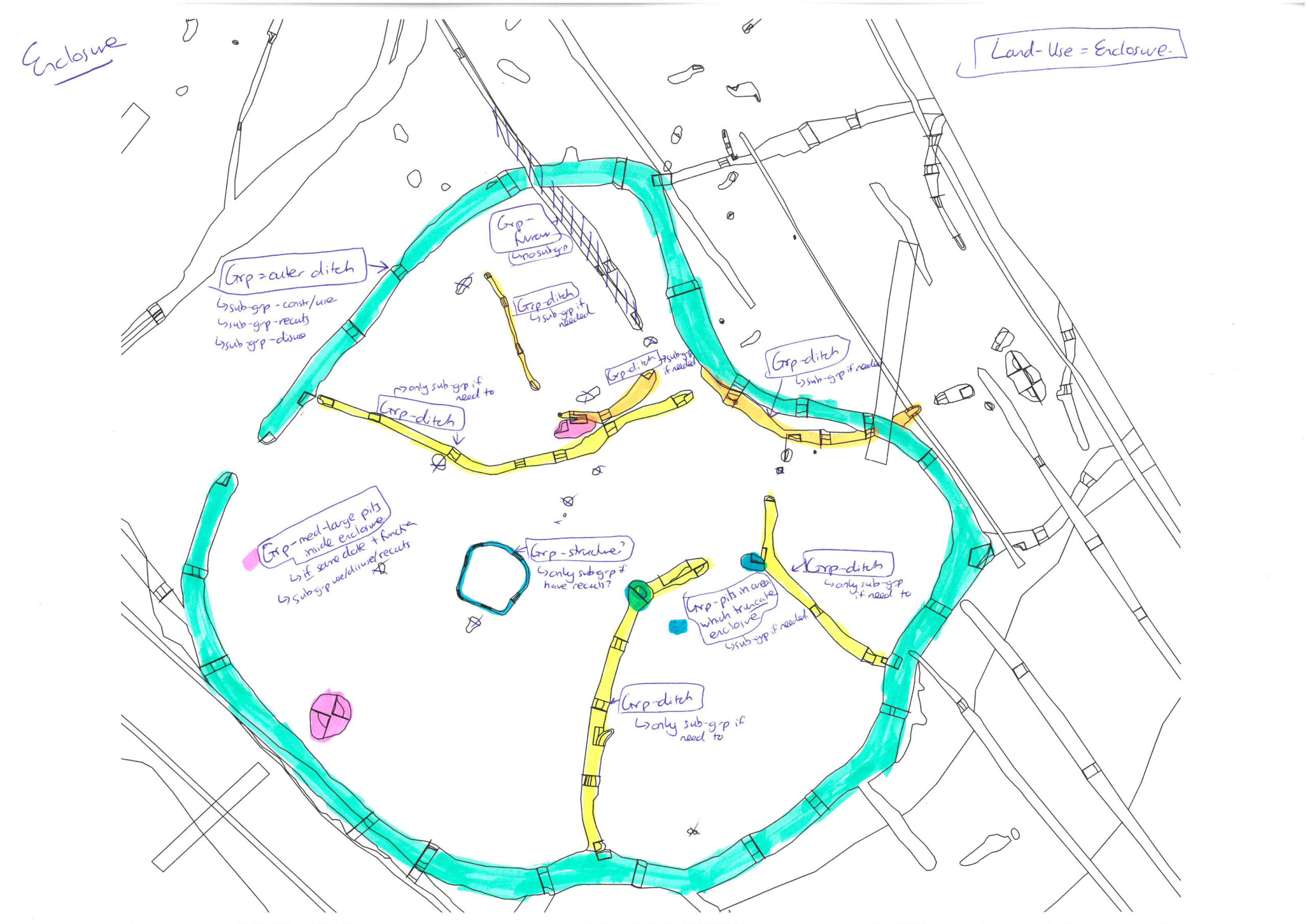
Stratigraphic (sub)groups might therefore include, a hearth or fireplace and its fills, or a midden pit and its fills (based on function), or for that matter a cluster of related pits (based on space and relative date). Alternatively it might include an occupation sequence (stratigraphic level), two sections of the same wall that has been bisected by a linear feature (such as a drain; colloquially: ‘same as’ contexts) or a series of walls which form part of the same structure (colloquially: ‘contemporary with’ contexts). Thus there is a lot of flexibility in what makes a stratigraphic group and therefore some variation in how the approach is applied conceptually. Whatever the case, the rationale for grouping should always be evidence based.
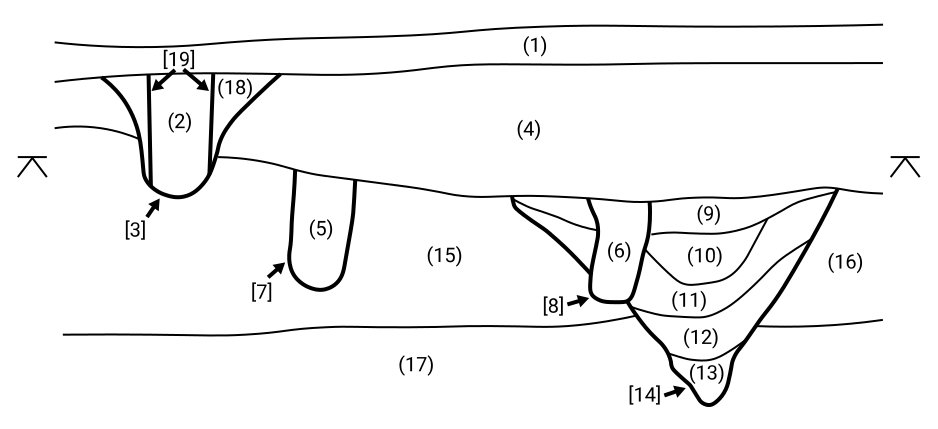
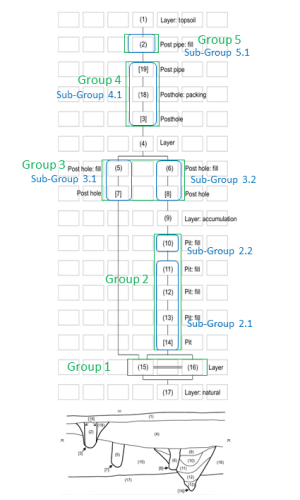
The above illustration needs updating
This two-step approach to subgrouping and grouping is a distinctly ‘deep-stratigraphic’ approach, designed to cope with the complexities of deep, and usually urban, stratigraphy. However, it is worth noting that not all organisations or projects use two tiers of grouping (i.e. ‘subgroup’ and ‘group’) but rather forgo the subgroup altogether. Ultimately this is usually a decision based upon the complexity of the stratigraphic sequence under analysis. In this case, where a sub-grouping step is not deemed necessary the ‘group’ will often be defined in a similar way to the subgroups outlined below, as a mechanism for pulling together related contexts into basic features (i.e. pits, postholes, linear cuts, architectural components etc.). It is important therefore for a project organisation to be transparent about the way in which grouping is deployed in their stratigraphic analysis as, despite a high degree of commonality in the actual structure of group data (contexts are assigned to groups essentially) there is quite a wide range of practice when it comes to how a group is conceived analytically.
To subgroup or not to subgroup
In certain instances, the relative complexity of an archaeological site may warrant a reconsideration of the traditional DUA/MoLA two-tiered approach to stratigraphic groups, consisting of ‘subgroups’ and ‘groups’. Instead, a single tier of groups, which may (confusingly) be referred to simply as “groups,” may suffice. In this alternative approach, the ‘group’ is the only primary grouping level, encompassing distinct episodes of activity and land use. By consolidating the stratigraphy into a single grouping level, the stratigraphic analysis of simple depositional sequences becomes more streamlined and easier to comprehend, particularly in cases where the site does not exhibit a high degree of complexity. This simplified approach ensures that the stratigraphic narrative remains coherent and accessible, while still capturing the essential chronological relationships and interpretive elements within the site’s archaeological record.
On groups and features (should grouping occur in the field or post excavation)
It is also worth noting that in some systems groups may be synonymous with the notions of a ‘feature’. This is a term often associated with Carver’s ‘feature-group’ approach to recording (Carver 1979, 1987) which is currently less commonly used in the UK commercial sector. In fact, Carver-style feature groups and a MoLA (or DUA)-style stratigraphic group represent two distinct approaches to organising and interpreting archaeological data.
A Carver-style feature group focuses on individual features within an archaeological site. Features in this case refer to discrete archaeological elements, such as pits, postholes, or walls. Carver-style grouping involves grouping these features based on shared characteristics, such as function, form, or spatial relationships. This approach emphasises the individual elements and their specific attributes and allows for a detailed analysis of the site’s components. Feature grouping typically occurs during the excavation stage of an archaeological project. As individual features are uncovered, archaeologists can begin to identify and group them based on their ongoing interpretation. This process arguably allows for a detailed understanding of specific elements within the site, and documentation of on-site ‘primary’ interpretations may serve to inform later (post-excavation) interpretations regarding activities, structures, or cultural practices associated with those features.
This relates to an often debated area in archaeological practice, which pertains to the stage of the process in which grouping should occur. In many instances, (particularly again in rural sites) it can be beneficial to employ a level of basic grouping in the field where circumstances clearly support it. For instance, grouping could be utilised in cases where multiple slots belong to a single ditch. Nevertheless, it’s essential not to over-group at this stage. The primary phase of grouping is typically best left to the post-excavation stage, which allows for a more comprehensive understanding and analysis of the archaeological context and interrelationships.
On the other hand, a MoLA-style stratigraphic group typically emphasises the vertical relationships between stratigraphic layers and the conventional wisdom suggests that this process should be done off-site, post-excavation when the stratigraphic sequences are analysed (although in reality many excavators will begin to draft groups during the excavation on the ‘running’ or draft matrix). Stratigraphic groups are created by grouping together the layers that share similar characteristics or depositional history. This approach prioritises the understanding of the site’s chronological and spatial sequence and the broader patterns and transformations over time.
It is important to note that these two types of grouping are not mutually exclusive and can serve to inform each other. However, MoLA-style of grouping is apparently the more wide-spread approach and forms the basis of the approach outlined below.