

Overview
Stratigraphic phasing in archaeology refers to the process of interpreting and determining the sequential order of archaeological remains. This concept is grounded in the principle of superposition, which states that in undisturbed stratigraphic sequences, the oldest layers are at the bottom, while the newest are at the top.
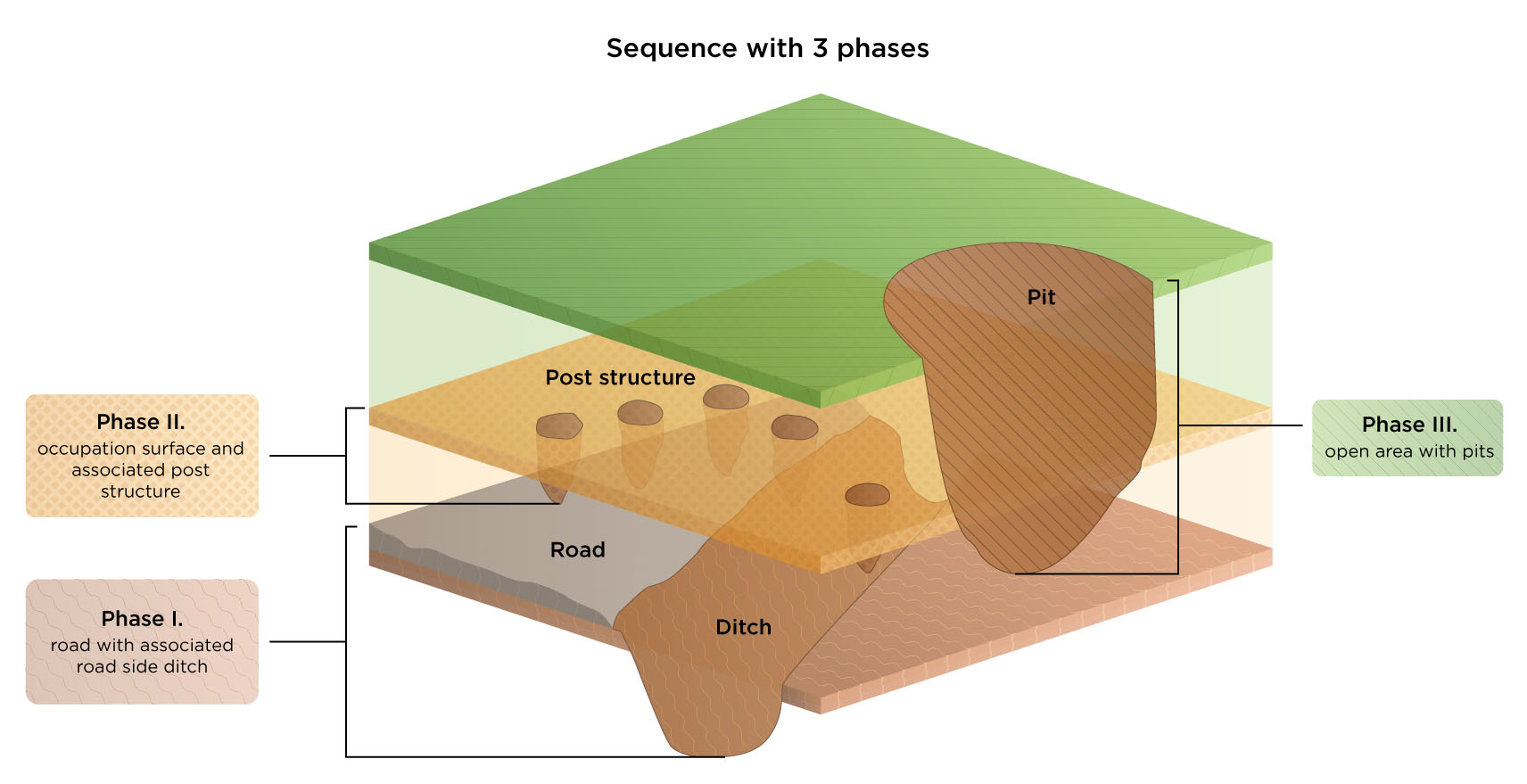
Each phase denotes a distinct timespan, most often with explicit or implied start and end dates, and will contain specific chronologically related stratigraphic units that fall within the identified timespan. As such the phase forms a key stage in the interpretation and meta-grouping of the stratigraphic sequence. This analytical technique facilitates and enables the analytical analysis of material culture across a site and generally underpins the chronological narrative of human habitation and cultural change at a particular site over time.
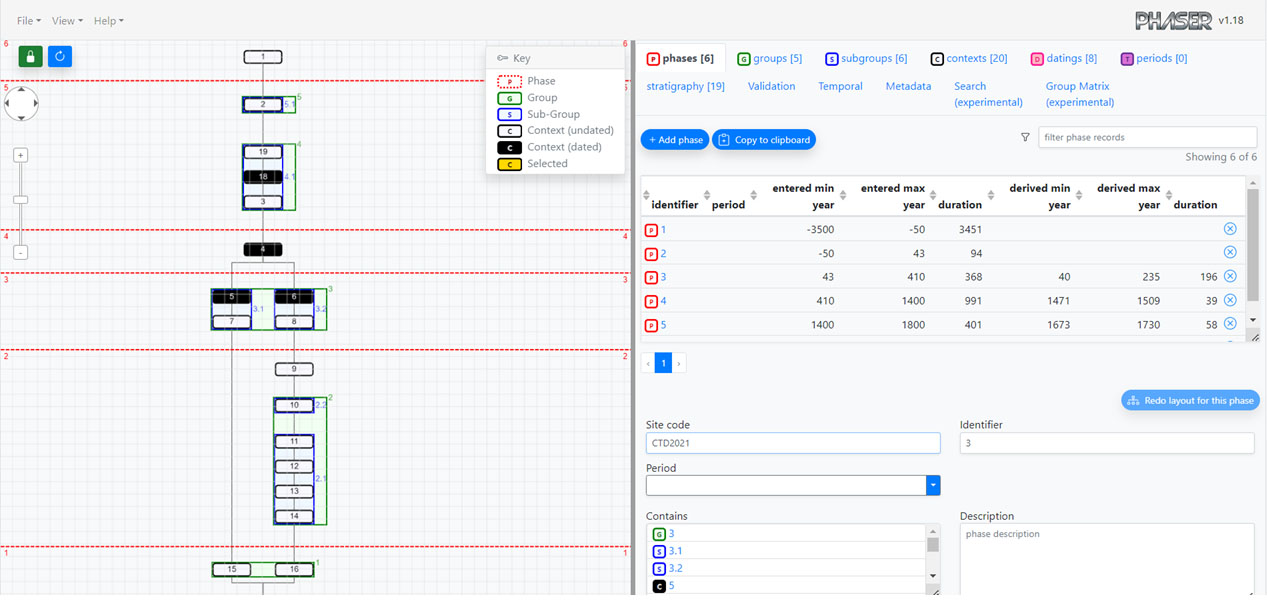
Phasing then, is the broad grouping of archaeological stratigraphy by relative chronology and in its simplest form generally involves seeking out related features, which are situated at the same stratigraphic level and ordering them chronologically. As such it is a higher level interpretative process and would ordinarily require a complete and checked stratigraphic sequence and matrix diagram. Spatial location and function can often play a part in deciding whether features belong to one phase or another, but the most crucial factor is the relationship between the chronology of the site/area and the stratigraphy. Hammer (2002, Section 3.6) suggests that ‘it may be necessary to clarify the stages of construction or deposition by dividing phases into subphases as necessary’.
An archaeological subphase might be seen as a more refined segment of time within a main archaeological phase. Just as a phase represents a distinct period of human activity across a specific site, a subphase further breaks down this time period to allow for a more detailed understanding of the sequence of events or changes. Subphases might denote differences in types of activity, changes in the style of artefacts or architecture, or subtle shifts in the nature of occupation within the broader time span of the main phase. This more granular stratigraphic chronological grouping can be used to highlight crucial nuances in the evolution of a site's cultural, technological, or architectural development.
It should be noted that on large sites, or sites where the stratigraphic phasing is spatially fragmented, it may be necessary to offer localised sub-phasing (of specific areas or trenches). Localised phase analysis focuses on the unique stratigraphic sequences and contexts within these areas to create a bespoke timeline, which might be tied into a broader site-wide phasing or just assigned to even broader regional periods. By definition a period does not necessarily form a discrete phase on a site, however all phases can probably be assigned to specific regional periods.
Note for purposes of this Handbook:
Phases here are defined as being distinct from Periods. An archaeological phase refers to a specific time frame at a particular archaeological site or part of a site. It is an analytical unit defined by archaeologists to interpret the stratigraphic and artefact sequences on a local scale.
An archaeological period, on the other hand, is a broader concept. It refers to a span of time defined across a large region, often encompassing multiple sites, and characterised by distinctive technology, culture, or type of social organisation (e.g. the Three Age System, and their regional subdivisions).