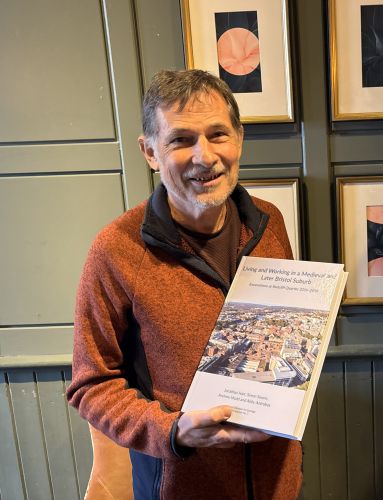
Andrew Mudd BA CertProfArch FSA MCIfA (971)
Obituary by Daniel Stansbie MCIfA (4911)
My former colleague Andrew Mudd, who died recently aged 69, was a dedicated professional archaeologist for more than fifty years, as well as a man with other wide-ranging interests and commitments. Andrew was born to Stanley and Joyce Mudd, who were missionaries, in Shillong, India, in 1956, the second of five children. He was educated initially in India, spending some of his early childhood in Darjeeling, where unimpeded views of Kanchenjunga from near the family home may have seeded a lifelong love of mountains and the outdoors.
Andrew’s family returned to the UK whilst he was still a young child and he went to school in southeast London, later studying for a degree in Geography at Exeter University, where he undertook his first archaeological fieldwork as a student volunteer. After university Andrew travelled back to India to work on an excavation in Pune, Maharashtra, returning to excavate in Bavaria and on sites in England, before taking the certificate in professional archaeology at Oxford University in 1983.
Andrew began his professional archaeological career in Oxford working for Oxford Archaeology (OA) (formerly Oxford Archaeological Unit), whilst simultaneously pursuing an MPhil degree at the Institute of Archaeology, UCL, which took him to Cojimes in Ecuador, allowing him to indulge his love of travel and the outdoors whilst carrying out survey and fieldwork on 80 sites dating to between 1000 BC and the Spanish conquest in the mid-16th century. One consequence of this work, and an intimation of future charity work and activism, was that Andrew founded a charity for the nearby Mache-Chindual nature reserve, which he visited during his field trips. However, it was at OA that Andrew established the foundations of his professional career, developing what would become an abiding interest in prehistory with a survey of the round barrows of the Oxfordshire Cotswolds’ published in 1984, which he carried out for the Oxfordshire Department of Museum Services.
Many other important and iconic excavations and publications followed through a career working at Northamptonshire Archaeology and finally for Cotswold Archaeology. During his career he led the fieldwork and co-authored the monograph on the A417/A419 road improvement scheme in the 1990s, excavating a section through Roman Ermin Street at the Cowley Roundabout, immediately next to Oxford Cotswold Archaeology’s recent excavations of the Roman settlement. Later he co-authored an important volume on the Crick ‘Iron Age Village’ in Northamptonshire. His publications for Cotswold Archaeology were so prolific that it is hard to pick out a highlight, but perhaps Andrew himself would have chosen the first monograph on the archaeology of Hinkley Point C Nuclear Power Station, co-authored with Jon Hart and Steve Rippon, which with the second monograph gathers together important evidence for settlement, farming and burial from the Neolithic to the post-medieval period, including important aDNA results from the post-Roman cemetery.
Throughout this period of his working life Andrew continued to explore wild places, going on walking and canoeing holidays, doing wind- and kite-surfing and camping. He also maintained a strong interest in civic activism and was a keen and active member of Amnesty International, later becoming the treasurer of the Stroud branch, having settled in Stroud later in his life. Towards the end of his life, Andrew became increasingly interested in ‘the local’, including local society, landscapes, produce, bands and brews, although he always retained his international outlook on life. He became chairman of the local walking group for which he led countless walks and holidays, and through his fundraising for Amnesty he became involved in organizing gigs for local bands at the Stroud Brewery.
Andrew will be fondly remembered by countless friends in archaeology and beyond. He is survived by his siblings, Margaret, Susan, Peter and Dorothy.