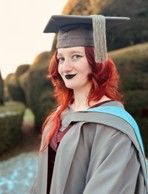
As a child I thrived being outside. I would spend every day after school helping to look after horses, goats, donkeys and many other nontraditional pets. My other interest was history. It was my favourite subject, and I would spend my spare time reading anything and everything history related. Naturally my love of the outdoors and history led me to a career in archaeology.
In 2020 I started an undergraduate degree at the University of Leicester. Studying archaeology at the height of a pandemic felt like an oxymoron. In my first year I had one in-person practical (magnetometry survey) with the rest being online.
Alongside my online studies I did an internship with ULAS, usually this would be in-person but instead this was also done virtually. I am very grateful that the Archaeology and Ancient History Department strived to give us as many opportunities as they could despite the struggles the pandemic handed them. They encouraged us to have student CIfA memberships and one of our module assignments was a statement of competence to help us understand the process of applying for PCIfA.
In my second year we began to have more in-person lectures and seminars as well as further fieldwork opportunities. I was able to go on the Ardnamurchan Transitions Project, which was the highlight of my entire university experience. I made many life-time friends, learnt skills that help with employability and got to put archaeological theory into a practical setting. My time at ATP became a foundational moment for my career. I have since volunteered on the project and hope that I can continue to do so.
After receiving my bachelors in Archaeology I did not want to stop learning and researching. I went on to get a Funerary Archaeology MSc from the University of York. Having the privilege to experience a different institution helped me to understand archaeology as a wider discipline. Researching archaeology changed my outlook on life. At this point I was ready to get out of the library and back into a muddy field.
I knew I wanted to be an archaeologist but I had not considered options outside of digging. I attended a CBA Yorkshire conference shortly after handing in my dissertation. There I spoke to many professionals regarding career paths and application advice, many advised that I look at CIfA. One person stood out. He asked me if I had ever considered geophysics. I enjoyed the magnetometry practical in university but never thought about it as a specialism. That night as I was checking archaeology bulletins, I came across a Trainee Archaeological Geophysicist position. I applied thinking I did not have the correct background for it. However, 3 months later I moved 3 hours south and started my new career.
I have been working for SUMO Geophysics for just over a year and I have not looked back. I have found that I have a greater understanding of archaeology as part of the construction sector as well as noninvasive ways of identifying archaeology. SUMO encouraged me to apply for PCIfA accreditation and supported me through the whole process. I found the specialist geophysics matrix helpful in tailoring my application.
My advice for anyone writing their statement of competence is that you probably have more skills relating to archaeology than you realise. The main skill I use every day did not come from university, it came from being comfortable outside in all weather. I have my mum to thank for my career as she always told me to “just put a coat on”.