
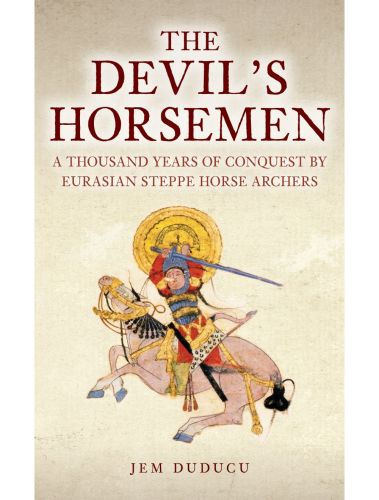
In his introduction Jem Duducu sets up the premise of a missed narrative of “culture, tolerance and trade” as a contrast with his title ‘a thousand years of conquest by Eurasian horse archers’. This book does indeed give us a brisk gallop through a tumultuous time period, with occasionally thrilling battles and interesting side quests into the Hashashin, Mongol navy, flaming camels as anti-elephant tactics and even a peek forward to the Cossacks and WWI. However this early promise to explore the cultures behind the conquest and to unpick the truth behind the titular ‘devils horsemen’ of western European myth is never fulfilled.
The book is hampered by its vast scope (both temporal and territorial) and the tendency to follow each culture through to its transition or demise leading to a constant feeling of backtracking and repetition. Meanwhile the sheer volume of conquest to be covered leaves little space for such discussions as the support, breeding of and cultural reverence for horses, involvement in trade (beyond brief mentions of the extraction of tribute and suppression of banditry) or even the material culture and practice of archery itself. It’s hard to feel that Duducu likes or is engaged by these steppe peoples. I finish the book not knowing how these people lived, but only where and when they died.
For those unfamiliar with this area of the time periods and cultures covered, Duducu gives a taster of where a new reader might start to engage. However with no footnotes and a very short bibiography (14 key works, leaning heavily on 4 previous works from the same author), it doesn’t give further references to delve into or pursue. It desperately needs more maps and the inclusion of a timeline.
Overall this book has an engaging writing style and multiple interesting anecdotes but is clearly aimed at the amateur enthusiast of military history rather than those with an anthropological or archaeological interest in nomadic cultures.
It would have benefitted from a less ambitious scope and more thoughtful commentary on any one of the chapters, many of which contain enough to be an excellent book in of themselves, but which are compromised by the attempt to contort them into a unified narrative. Duducu concludes with a plea for more understanding, respect and study of Eurasian nomadic society, with which I would heartily concur.