
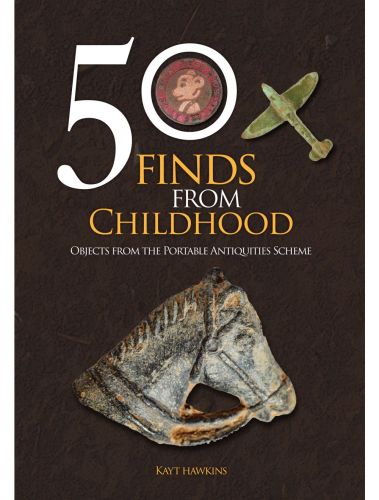
The Portable Antiquities Scheme (PAS) has recorded well over a million objects found by metal detectorists and the public. Along with many Amberely Publishing books that bring some of those finds to a wider readership, Kayt Hawkins’ 50 Finds from Childhood an informative, celebratory and joyous read.
At the time of writing, there were over 2000 ‘toys’ recorded on the PAS database, and this book includes several of them. The book, in under a hundred pages, encompasses a wider view of childhood by including the health and wellbeing of mother and child, through to education and work along with the toys and games played. Amongst the delights, we are reminded that, until the early twentieth century, the early years were dangerous with 30 to 50 per cent mortality rates, and that childhood itself was tough.
50 Finds from Childhood is beautifully illustrated throughout, and alongside 50 finds from the PAS, we have images of objects and paintings from museums around the world. They give pause for thought and put the finds into context as well as bringing joy and, at times, deep concern…
The Roman gold leaf plaque from East Sussex in the form of a uterus (found in two parts) reminds us that concerns about fertility and childbirth have and always will be of concern. It is shown alongside a Roman clay votive offering in the shape of a uterus in the Wellcome collection and a Roman gold phylactery found in Oxfordshire, the charm to ensure safe childbirth.
The chapter on education and work includes a small pot, a possible ‘practice’ piece, and a hand axe notable for its small size, suggesting children may have learnt the skills of production alongside adults. And tiny thimbles show needlecraft was a key skill of children of all classes, particularly for girls.
The dolls, figurines, miniature household objects and toy weapons would have allowed children to ‘play’ at being grown up, and the miniature objects are quite remarkable. The detail on the toy mounted soldier, the miniature gridiron with its fine fish and the tiny cauldron is astonishing and their casual loss likely lamented. And the story of the post-medieval Frozen Charlottes, their origin poem and subsequent folk song that made them popular sends a shiver down the spine.
Hawkins’ book is an absorbing addition to the 50 Finds… series and Is an accessible way of bringing many of the fascinating finds from the PAS database to a wider audience. It will also prove to be essential for the specialist and researcher, academic, and citizen scientist.