
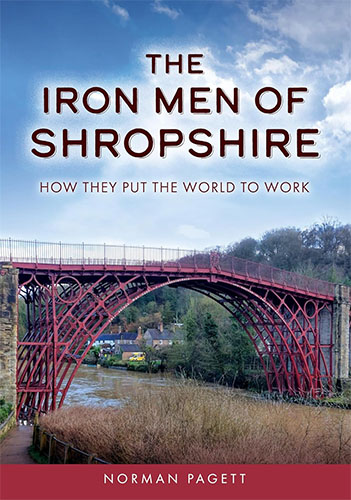
This book is a study of the businessmen and iron masters who developed Shropshire's iron industry during the 18th and early 19th centuries, when it was at the forefront of industrialisation and iron production innovation in Britain. The geographical area covered by this book was one the cradles of industrialisation and encompasses the industrial monuments of the Ironbridge World Heritage Site, many of which are discussed in the volume.
The first five chapters trace the development of the iron business established by Abraham Darby (1678-1717) at Coalbrookdale in 1708, across the 18th century, which was run by his later family and their Quaker business partners. Beginning with Darby himself, Pagett goes on to study Richard Ford, Abraham Darby II, Richard Reynolds and Abraham Darby III, and William Reynolds. Each chapter explains the iron processes developed and employed at a variety of sites, often with useful explanatory diagrams and site descriptions. The final two chapters, part two of the volume, look at four engineers working within Shropshire: Thomas Telford and William Hazledine, and John Wilkinson and James Watt, the transport networks they developed in Shropshire and the industrial archaeology sites still visible.
The concept of the history of the heroic engineer goes back to Samuel Smile's 'Lives the Engineers' published in 1862. Norman Pagett's twist on the genre is to include not just relevant engineering history, but to discuss and describe the key industrial and domestic sites associated with each individual.
Frustratingly, the book has neither an index (quite common in Amberley's shorter book series and only somewhat offset by helpful chapter titles) nor, more seriously, any references. Nevertheless, the volume is a useful popular introduction to the businessmen of Shropshire's iron industry if the 18th and 19th centuries and their industrial archaeology legacy. For those interested in following the story of these men, and the industrial sites they helped create, in more detail, then the pages of the journals 'Transactions of the Shropshire Archaeological and History Society', 'Historical Metallurgy', and 'Industrial Archaeology Review' are the places to go.