
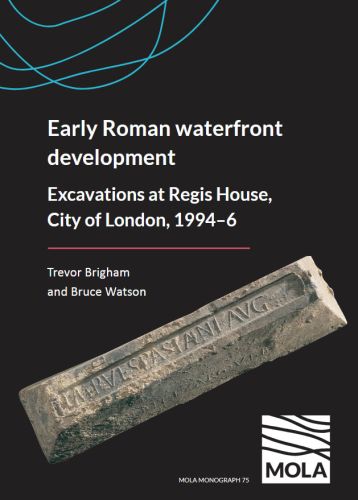
Early Roman Waterfront Development: Excavations at Regis House, City of London, 1994–6 is, as the name suggests, an excavation report of a developer funded excavation in the land enclosed by Monument Street, King William Street, Lower Thames Street and Fish Street Hill in the City of London. Although currently some distance from the modern river course, the site includes some of the earliest Roman wharves in London, dating from 52CE, together with parts of the first Roman bridge across the Thames. Remains on the site include evidence of the destruction of Londinium during the Boudican revolt of 61CE, the rebuilding of the site and the construction of a number of wharves extending further into the river channel, all sealed by the debris from another fire, in 125 – 130 CE. Later development continued into the 3 Century, overlain by a ‘dark earth’. Medieval occupation of the site is not covered by this report.
The report incorporates the results of the 1994 -6 excavations and post-excavation analysis together with earlier work on the site, largely carried out between 1929 and 1931, and places the results in context with excavations of Roman material in the vicinity such as 1, Poultry, Pudding Lane and the Bloomberg excavations, providing a picture of the first 200 years of Roman Londinium, particularly with respect to the river.
The report contains specialist reports covering the timberwork of excavated wharves, accessioned finds, pottery, glass, coins, lead ingots, bone, leather, plant remains, building material, lithics and dating. As with most archaeological reports, not all reports will be of interest to all readers, but the timberwork, glass, lead ingots and leather remains on this site are of particular relevance to the site and to the early history of Londinium.
The accessioned items together with the leatherwork and timberwork highlight the involvement of the Roman army with the earliest settlement at Londinium and the construction of wharves and the first bridge across the Thames. The timberwork also provides additional evidence of the Roman waterfront, complementing the existing corpus of work along the Roman waterfront (e.g. Bateman and Milne, 1983, Brigham 1990, Mackinder 2015, Miller, 1982, Milne, 1985, Swift 2008).
Glassworking remains include the remains of three glassworking furnaces, with associated glassworking waste, which together with material recovered from 1 Watling Street, 2–12 Gresham Street and Blossom’s Inn comprises the earliest glassworking remains in Londinium and some of the earliest evidence for glass blowing in Britain.
The publication is designed as an academic report, rather than as a popular publication so is designed to be a scientific record rather than a synthetic narrative. As noted above, readers will gravitate to their own particular specialisms and interests, but Chapter 11: Regis House and Roman London provides a useful summary of the site as a whole and serves to provide context for the specialist reports. The core text is split into distinct phases, which are dealt with separately as one would expect in an archaeological report, underlining that this book is not aimed at the lay reader, but more at the archaeological specialist. That said the text is clear and coherently written and the book is copiously illustrated. The report leans heavily on perspective reconstructions and photographs to illustrate wharfside development, but is not afraid to reproduce plans and sections where necessary and specialist reports are comprehensively illustrated.
In summary this is an excellent report and is recommended for archaeologists with an interest in Roman London, early harbours and Roman woodworking (or, indeed, researchers into the many artefact types studied here), but may be a little too intensive for a more general reader.
Bateman, N and Milne, G (1983) A Roman harbour in London: Excavations and observations near Pudding Lane, City of London 1979-82 Britannia 14 207-26
Brigham, T (1990) The late Roman waterfront in London Britannia21 99-183
Mackinder, A (2015) Roman and medieval revetments on the Thames waterfront MoLA Archaeology Studies Series 33
Miller, L (1982) Miles Lane: the early Roman waterfront London Archaeology 4 143-7
Milne, G (1985) The Port of Roman London London: Batsford
Swift, D (2008) Roman waterfront development at 12 Arthur Street, City of London MoLAS Archaeology Studies Series 19
Early Roman waterfront development: excavations at Regis House, City o – Shop MOLA