Methods
At its core the physical process of phasing is very simple, once it has been decided which key (‘nodal’) features mark the interface between each phase, you simply move the blocks of stratigraphy that lie above or below those features downwards or upwards in your matrix respectively. Pearson and Williams (1993, 95) describe this process in terms of “context-series”; that is: discrete strings of linked contexts or stratigraphic units identified within the Harris Matrix sequence diagram. Roskams (2001, 257-261) discusses the merits of this approach in some detail, as it relates to grouping stratigraphy. He also suggests that the result of ordering the matrix by phase can be visualised in the matrix diagram itself (ibid.I, 265).
In essence once the matrix is ordered and the ‘context-series’ are pulled 'into phase’, it should be possible to draw a horizontal line across the stratigraphic matrix, either above or below the defining features (dependent upon whether that feature marks the end of a phase or the beginning of another).
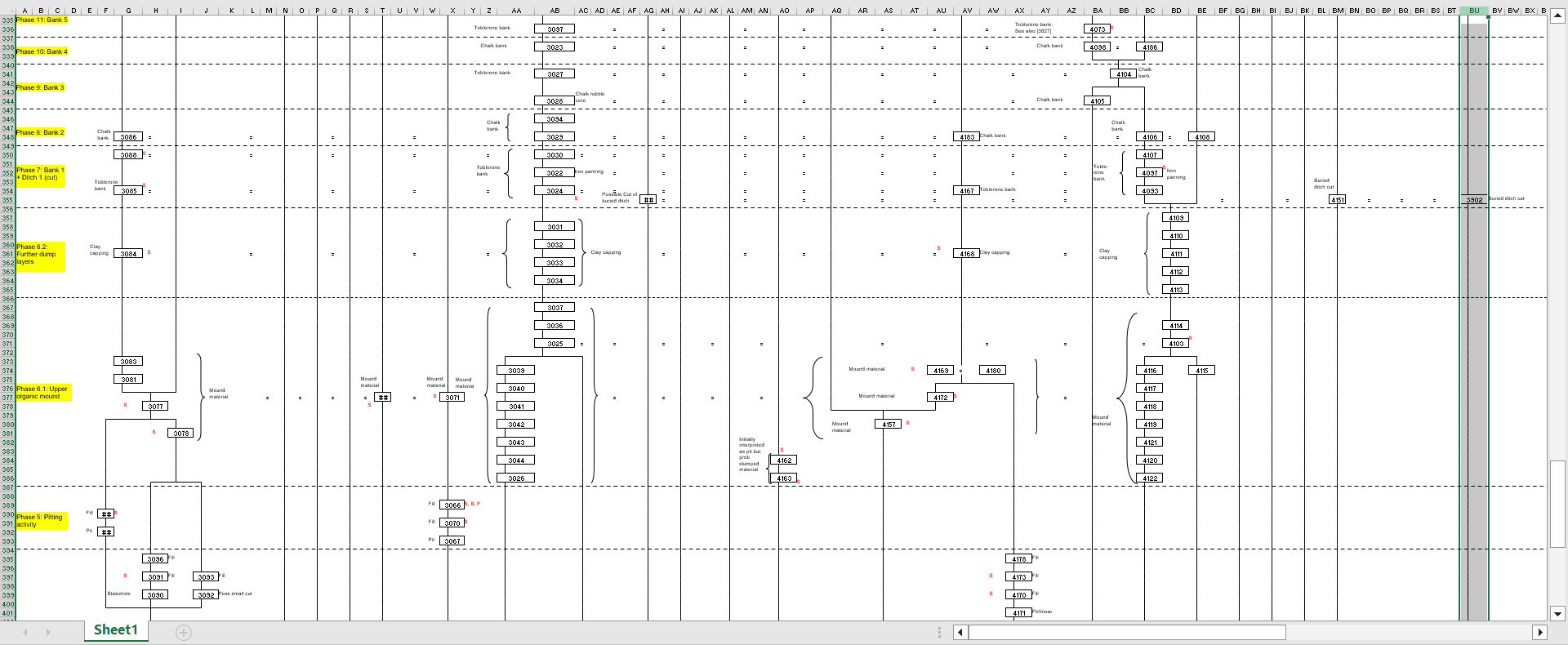
Identifying the defining stratigraphic units of a phase is the interpretative element of the process and it is largely up to the original excavator, or individual responsible for analysing the stratigraphy, to define this. Examples of phase indicators (which may form ‘nodal’ points in the matrix are floors throughout a structure which mark the beginning of an occupation sequence (‘Occupation Phase’), architecture which was founded at the same stratigraphic level (both within one structure or across many) (‘Construction Phase’), robbing pit clusters or tumble sequences (‘Post-Abandonment’ or ‘Demolition Phase’), etc.
Phasing often also falls into broad interpretative categories such as ‘Natural’, ‘Occupation’, ‘Construction’, ‘Demolition’, ‘Preparation’, ‘Abandonment’ or ‘Modern’, and may even respect broader periodisation on less complex sites or parts of the sequence (i.e. ‘Medieval Pitting’; all of which should be clearly defined in the stratigraphic narrative). The exact terminology can vary between sites and projects because identified phases are often site or area specific, since they are implicitly tied to the local stratigraphy. On larger sites one might make a distinction between ‘Site-Wide Phasing’ (where the stratigraphy is essentially proven between various archaeological interventions or structures across the site) and ‘Local Phasing’ (where these relationships aren’t fully understood across the site or are missing in places). In theory phasing can always change, subject to further work (this is especially true of local phasing), where projects run from season to season, or are otherwise revisited in subsequent archaeological interventions.
It should be noted that grouping can technically be done at any time after the matrix is established, before the phasing is finalised. However, it is generally easier to phase with a simpler matrix, particularly in/on larger areas and sites, in which case it might be helpful to group your stratigraphy before phasing and then phase the group matrix. As such it is generally better, if you are using groups, to complete the grouping first. That said, phasing can help you to finalise groups so the process of grouping and phasing is closely related and may be iterative. It is important to remember however, that phasing has to be done during the post-excavation analysis, whereas stratigraphic grouping can begin earlier and be optional. Groups (and particularly subgroups if applied) can later be used to help structure the site’s stratigraphic narrative (see discussion in the section on subgrouping and producing a narrative).
Phase numbering is often assigned upon a site by site basis, but may be subject to project or organisational conventions which should be decided upon at the outset of any stratigraphic analysis. Generally it is good practice to number phases in the order of sequential depositions (i.e. from the bottom of the sequence up) as this will generally align with the stratigraphic narrative.
Don't think the above illustration is quite right
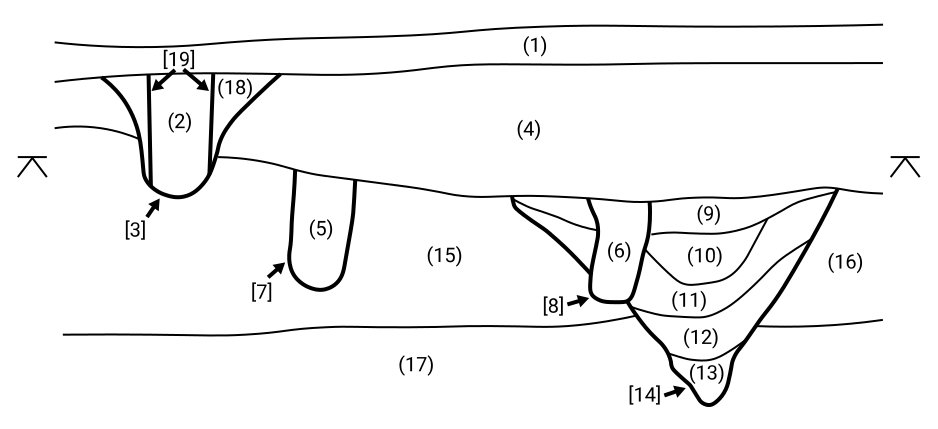
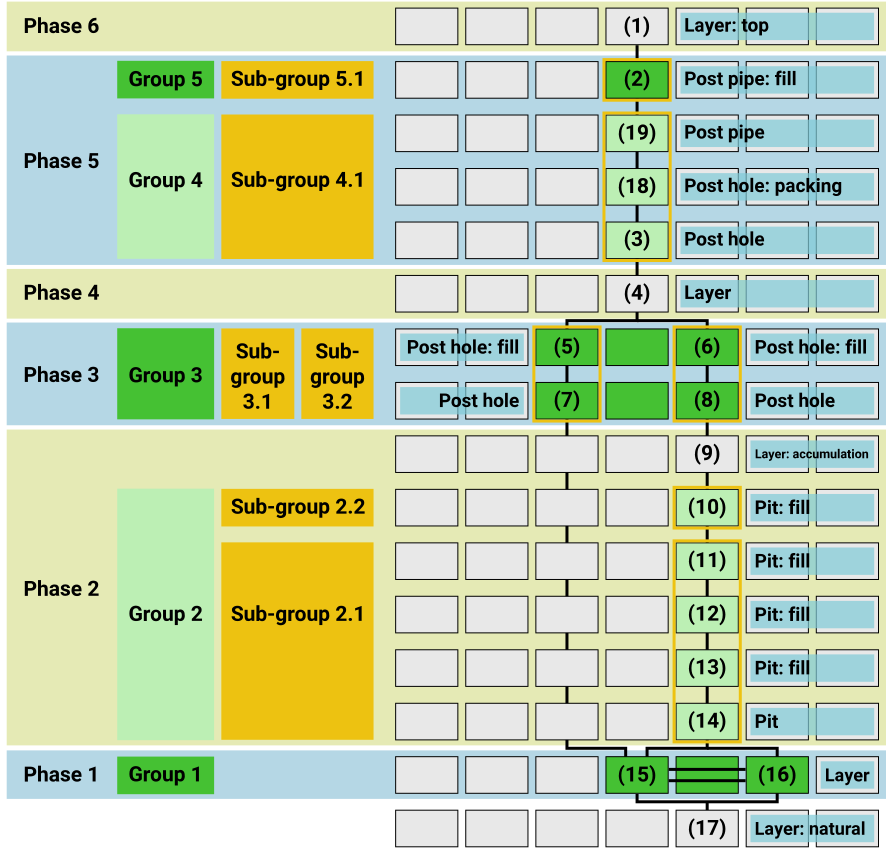
[Video] Animation showing interpretive grouping and phasing added to the matrix diagram of the example section, based on interpretation of how the sequence of deposits and cuts would have occurred. Phasing denoted on the matrix diagram is accompanied by animated highlighting of the sequence of associated phases on the section drawing. (note animation speed can be adjusted or paused)
Current Good Practice
Some general rules for Phases
- Phases are a special form of sequencing a spatiotemporal data set (the sequence) using the spatial (plans) & temporal (dating evidence) records , usually operating at an intra-site scale;
- as such, Phases will be defined by a set of concurrent sequential date ranges predefined by site/organisation (e.g. Early Iron Age, Mid Iron Age, Late Iron Age).
- Phases must contain at least one Unit/Context.
- all Unit/Contexts, Group/Features and Sub-Groups should (as a final check) be assigned to a Phase. This would be a final check when all phasing is considered complete.
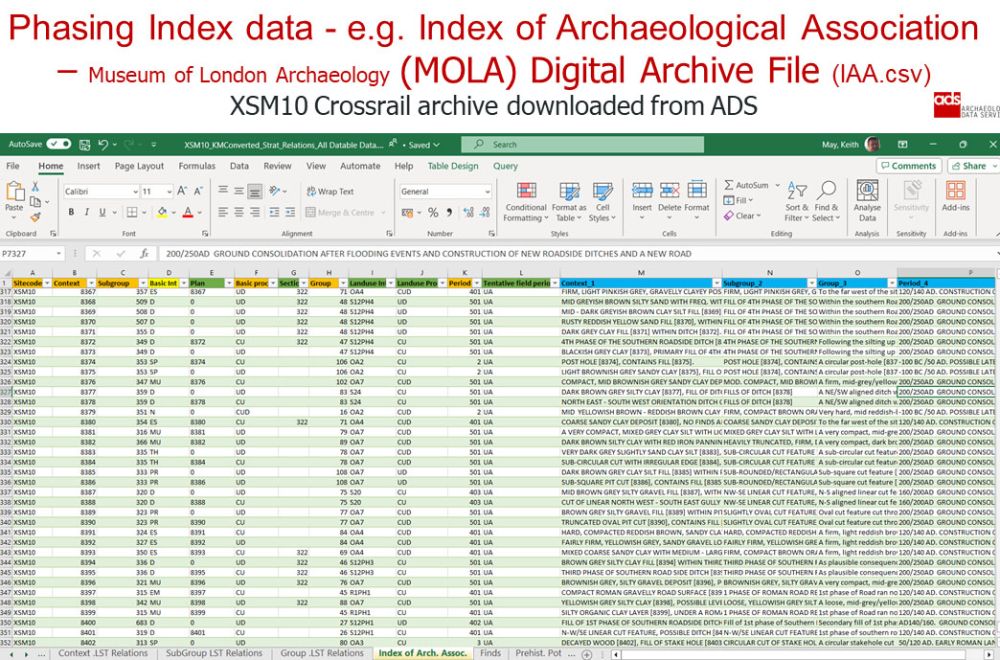
- Phases should be documented in a Phase Index such as a spread sheet table that documents the key stratigraphic, grouping and phasing relationships between contexts upon an archaeological site (see Index of Archaeological Association for example below)
- All Phases should be allocated a timespan with start date and end date.
- Phases should be allocated to a Period/Level (if Periods are used).
- Phases require some clearly defined Title or Code, in order to rationalise their existence (these may be predefined by site/organisation).
- Phases should be across all strands of the matrix (i.e. Site-wide) unless using sub-phases.